
KSQ Type Pump Vibration Isolation Base: Design, Working Principles, and Engineering Selection Guide
Designed for severe service industrial pipeline applications. Engineered, tested, and certified in accordance with API, ASME, and ISO standards for dependable isolation and flow control.
Detailed Description & Specifications
KSQ Type Pump Vibration Isolation Base: Design, Working Principles, and Engineering Selection Guide
By Shanghai Songxia Shock Absorber Co., Ltd. | Technical Department
Pump vibration control is an important consideration in HVAC systems, industrial water circulation, building services, and mechanical equipment installations. Uncontrolled pump vibration can be transmitted through foundations, structural floors, connected piping, and equipment supports.
A properly designed pump vibration isolation system can help reduce structure-borne vibration, improve the installation environment, and limit the transmission of dynamic forces to surrounding building structures.
The KSQ Type Pump Vibration Isolation Base from Shanghai Songxia Shock Absorber Co., Ltd. is a steel-framed isolation base incorporating spring support elements for pump-related applications.
This technical article introduces the visible structural features of the KSQ base, explains the principles of spring vibration isolation, and discusses essential engineering parameters for pump installation and system selection.
1. KSQ Pump Vibration Isolation Base: Product Overview
[Insert the original KSQ product photograph here]
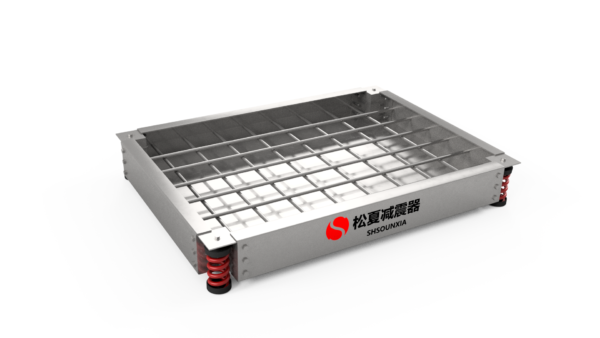
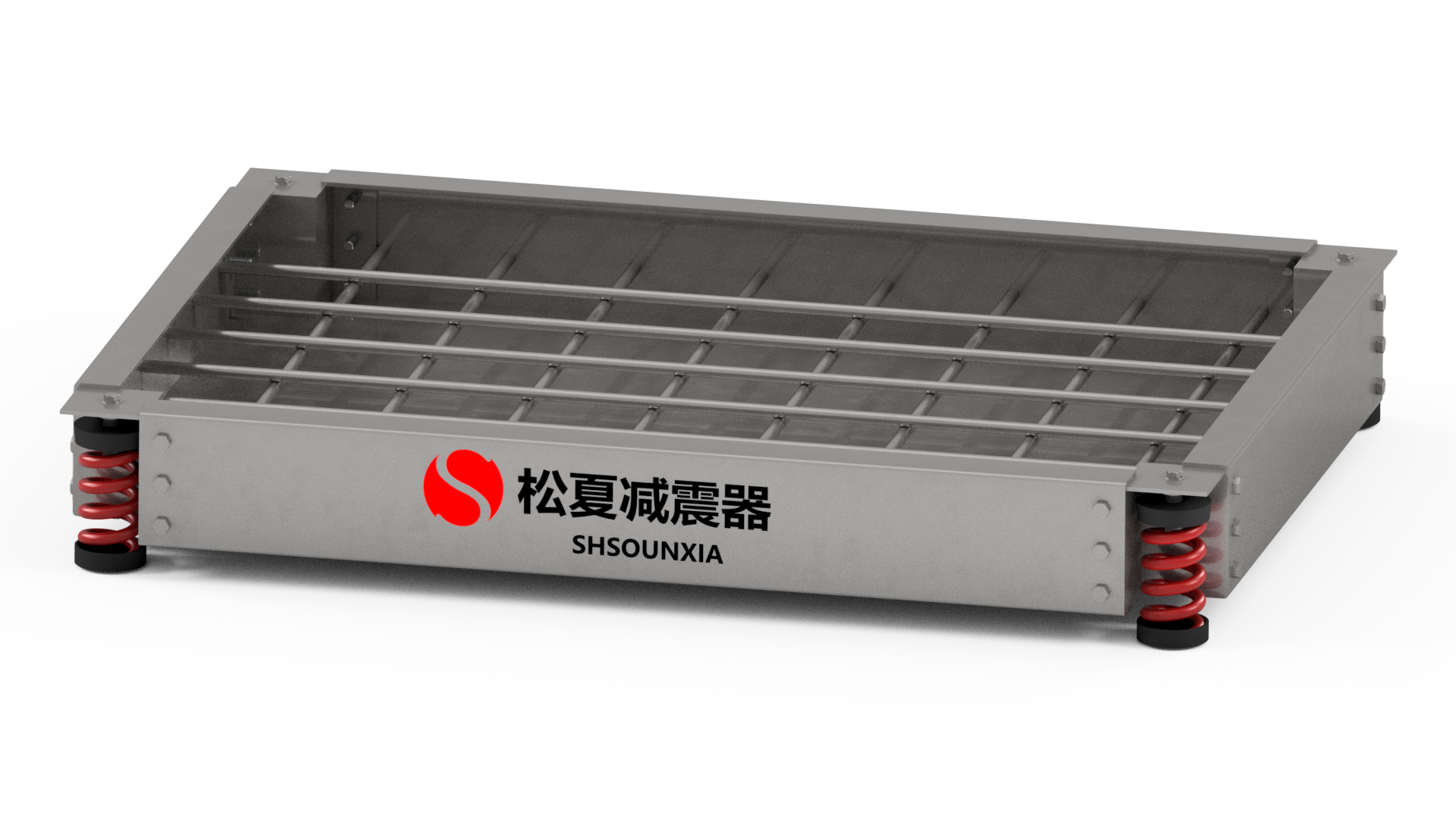
Image caption: KSQ type pump vibration isolation base featuring a rectangular steel frame, open metal grating, and red coil spring support assemblies.
The KSQ pump vibration isolation base shown in the product image features a rectangular metallic support structure with an open grating arrangement across its upper area.
Red coil springs are visible near the corners, positioned between the main supporting frame and lower mounting interfaces.
The open frame and grating arrangement distinguish this product from a conventional solid steel machine mounting plate.
Depending on its specific design, a steel-framed spring isolation base may be used as part of a pump mounting system intended to reduce vibration transmission between the equipment assembly and its supporting foundation.
However, the load-bearing capacity of the grating, permitted mounting locations, spring ratings, and installation requirements must be verified against the KSQ product documentation.
The image itself does not establish whether the frame is designed to receive concrete infill or additional inertia mass.
2. Why Do Industrial Pumps Need Vibration Isolation?
Centrifugal pumps and other rotating pumping equipment generate dynamic forces during operation.
The principal causes of vibration may include:
- Rotor mass imbalance
- Shaft misalignment
- Bearing defects
- Mechanical looseness
- Hydraulic pulsation
- Cavitation
- Pipe strain and external loading
- Motor-related electromagnetic forces
Not every vibration problem can be solved through external isolation.
For example, severe imbalance, cavitation, or defective bearings should be corrected at the source before isolation measures are considered.
A spring isolation base primarily addresses the transmission path between the pump assembly and its supporting structure.
When correctly selected, the isolation system can reduce the dynamic force transmitted to the building or foundation over the appropriate frequency range.
3. Structural Design of the KSQ Spring-Isolated Pump Base
3.1 Rectangular Steel Support Frame
The principal steel frame provides a structural interface for the equipment support arrangement.
Its required stiffness depends on the supported equipment mass, mounting geometry, motor-pump alignment requirements, and operating loads.
A frame that lacks sufficient rigidity may introduce local bending modes, which can affect equipment alignment and vibration behavior.
Therefore, structural stiffness must be evaluated in addition to spring selection.
3.2 Open Metal Grating
The visible upper structure incorporates a metal grating arrangement.
Its mechanical function must be determined from the product design documentation.
If the grating is intended to support loads, its allowable loading and attachment requirements must be verified.
If the frame is designed for concrete infill, the manufacturer should specify the required concrete volume, reinforcement, curing requirements, and resulting assembly mass.
3.3 Coil Spring Isolation Supports
The visible red coil springs provide elastic compliance between the upper assembly and the lower support interfaces.
The dynamic characteristics depend on spring stiffness, supported mass, preload, and system configuration.
For spring-isolated pump bases, the selection of spring stiffness is one of the most important steps in achieving an appropriate natural frequency.
3.4 Foundation and Mounting Interfaces
The lower mounting points transfer static and dynamic loads to the foundation.
Correct installation requires suitable anchorage, support geometry, spring alignment, and adequate clearance for expected movement.
The overall installation must also account for connected pipes and any mechanical restraints.
4. Working Principle of Spring Vibration Isolation
A spring vibration isolation system uses elastic supports to reduce the transmission of dynamic forces between machinery and its foundation.
For an idealized single-degree-of-freedom system, the undamped natural frequency is:
fₙ = (1 / 2π) × √(k / m)
Where:
- fₙ = natural frequency, Hz
- k = total equivalent spring stiffness, N/m
- m = supported mass, kg
For multiple vertical springs acting in parallel, the equivalent vertical stiffness is approximately the sum of the individual spring stiffnesses, assuming the supports move together without significant rotational coupling.
For a linear vertical spring system, static deflection is related to natural frequency through:
fₙ = (1 / 2π) × √(g / δ)
Where:
- g = gravitational acceleration, approximately 9.81 m/s²
- δ = static deflection, m
This equation is particularly useful for preliminary spring isolator selection.
Example: The Effect of Static Deflection
Consider two idealized spring support arrangements.
Case A: Static deflection of 10 mm
The corresponding natural frequency is approximately:
fₙ ≈ 5.0 Hz
Case B: Static deflection of 25 mm
The corresponding natural frequency is approximately:
fₙ ≈ 3.15 Hz
These are theoretical values for linear systems and do not represent verified KSQ product performance.
The example shows that a greater static deflection generally corresponds to a lower vertical natural frequency.
However, additional deflection requires sufficient installation clearance, appropriate spring travel, and adequate mechanical stability.
5. Pump Operating Speed and Vibration Isolation Efficiency
Pump rotational speed is an important input when selecting spring isolators.
The fundamental rotational frequency can be calculated using:
f = N / 60
Where:
- f = rotational frequency, Hz
- N = rotational speed, rpm
For a pump operating at 1,450 rpm:
f ≈ 24.17 Hz
For a pump operating at 2,900 rpm:
f ≈ 48.33 Hz
These frequencies correspond to rotational speed and should not be interpreted as the complete vibration spectrum of the pump.
Actual vibration can also include harmonics, blade-passing frequencies, bearing-related components, hydraulic disturbances, and structural resonances.
For a simplified viscously damped isolation system subjected to harmonic excitation, force transmissibility can be represented as:
T = √[(1 + (2ζr)²) / ((1 − r²)² + (2ζr)²)]
Where:
- T = force transmissibility for the idealized model
- ζ = damping ratio
- r = f / fₙ = frequency ratio
The model predicts vibration attenuation when the frequency ratio exceeds approximately √2.
At frequencies close to resonance, vibration amplification may occur.
For a simplified numerical illustration, consider:
- Pump rotational frequency: 24.17 Hz
- Isolation natural frequency: 5 Hz
- Damping ratio: 0.05
The frequency ratio is approximately 4.83.
Using the idealized transmissibility equation, the predicted transmissibility is approximately 5.4%.
This corresponds to approximately 94.6% theoretical force-transmission reduction at the specified frequency.
This is an illustrative calculation, not a tested performance rating for the KSQ product.
Actual vibration transmission may differ because of multidirectional motion, frame flexibility, connected piping, damping behavior, and foundation characteristics.
6. Spring-Isolated Pump Base vs. Concrete Inertia Base
Industrial pump installations may use different base configurations depending on their mechanical and dynamic requirements.
A steel spring-isolated base and a concrete-filled inertia base are not automatically interchangeable.
Steel Spring-Isolated Base
A steel spring-isolated base uses a supporting frame and elastic supports.
Advantages may include reduced structural mass and relatively straightforward installation.
However, sufficient structural rigidity and proper equipment mounting must be maintained.
Concrete Inertia Base
A concrete inertia base incorporates additional mass and structural rigidity through a properly designed reinforced concrete assembly.
The extra mass may help reduce certain motion responses and provide a rigid mounting structure.
Nevertheless, adding mass alone does not guarantee improved isolation. Spring stiffness, system modes, foundation constraints, and loading must be evaluated together.
KSQ Product Consideration
The KSQ product image shows an open metal framework and spring supports.
Whether this particular KSQ configuration is intended to be used as a concrete-filled inertia base must be confirmed by the manufacturer.
The product should not be advertised as a concrete inertia base unless the actual model specification supports that classification.
7. The Importance of Pump and Piping Isolation
One of the most common mistakes in pump vibration control is concentrating only on the pump support while neglecting the connected piping.
Even when a pump is mounted on properly selected spring isolators, rigid piping connections can create an alternative vibration transmission path.
Piping Connections
Piping connections should be designed to accommodate the expected movements of the isolated equipment without imposing excessive nozzle loads.
Appropriate flexible connectors or engineered pipe arrangements may be necessary.
Pipe Supports
Pipe supports near the pump must be evaluated to avoid excessive load transfer to the pump and isolation system.
Pressure and Thrust Forces
Flexible piping connectors can introduce pressure thrust and other forces.
Where necessary, appropriate restraints or control arrangements should be designed to manage these loads.
Installation Alignment
Pump and motor alignment must be checked in the intended operating condition.
A spring isolation system should not be allowed to compromise shaft alignment or introduce excessive pipe strain.
A complete pump vibration isolation solution therefore requires coordination between the pump, base, pipework, foundation, and vibration control components.
8. KSQ Pump Isolation Base Engineering Selection Parameters
Correct selection begins with the mechanical and operational characteristics of the pump installation.
| Parameter | Engineering Significance |
|---|---|
| Pump and motor mass | Determines total supported equipment weight |
| Base assembly mass | Contributes to total isolated mass |
| Center of gravity | Influences individual spring loads |
| Pump operating speed | Helps identify excitation frequencies |
| Spring stiffness | Determines system natural frequencies |
| Static deflection | Influences vibration isolation behavior |
| Spring travel | Defines allowable movement range |
| Base frame rigidity | Influences structural deformation and alignment |
| Pipe connection loads | Can affect static and dynamic support conditions |
| Foundation stiffness | Influences coupled vibration behavior |
| Environmental conditions | Affect corrosion protection and component selection |
For a four-point isolation arrangement, the average spring load is:
Favg = W / 4
Where W is the total supported weight force.
This average is only suitable for preliminary estimation.
The actual load on each support depends on center-of-gravity location, support geometry, and static equilibrium conditions.
Uneven spring loading can lead to different deflections and may create rotational instability.
9. Common Installation Mistakes
Several common mistakes can reduce the effect
Request A Free Quote
Interested in KSQ Type Pump Vibration Isolation Base: Design, Working Principles, and Engineering Selection Guide? Share your required size, pressure class, material and quantities, and our team will get back to you within 24 hours.