
SDB Type Pneumatic Vibration Isolators: Design, Working Principles, and Precision Equipment Applications
Designed for severe service industrial pipeline applications. Engineered, tested, and certified in accordance with API, ASME, and ISO standards for dependable isolation and flow control.
Detailed Description & Specifications
SDB Type Pneumatic Vibration Isolators: Design, Working Principles, and Precision Equipment Applications
By Shanghai Songxia Shock Absorber Co., Ltd. | Technical Department
Vibration control is an important aspect of modern industrial equipment design, especially in applications where dynamic disturbances can affect measurement accuracy, process stability, and mechanical performance.
The SDB type pneumatic vibration isolator from Shanghai Songxia Shock Absorber Co., Ltd. is designed as a compact pneumatic isolation component for integration into industrial vibration control systems.
Unlike conventional rigid machine supports, pneumatic vibration isolators use compressed air and compliant mechanical elements to provide elastic load support. When properly engineered, pneumatic isolation systems can reduce vibration transmission and help maintain suitable operating conditions for sensitive equipment.
This article introduces the structural configuration of the SDB type pneumatic vibration isolator, examines fundamental vibration isolation principles, and discusses engineering applications and selection requirements.
1. SDB Type Pneumatic Vibration Isolator: Product Overview
[Insert the SDB pneumatic vibration isolator product image here]
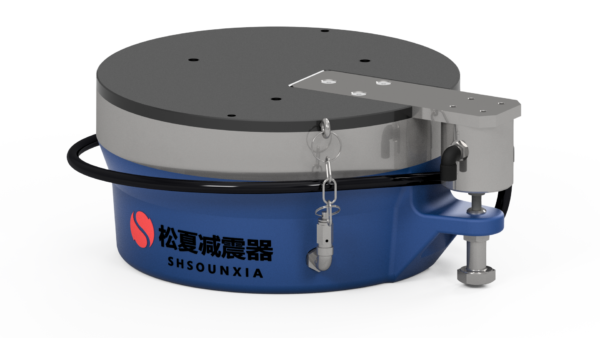
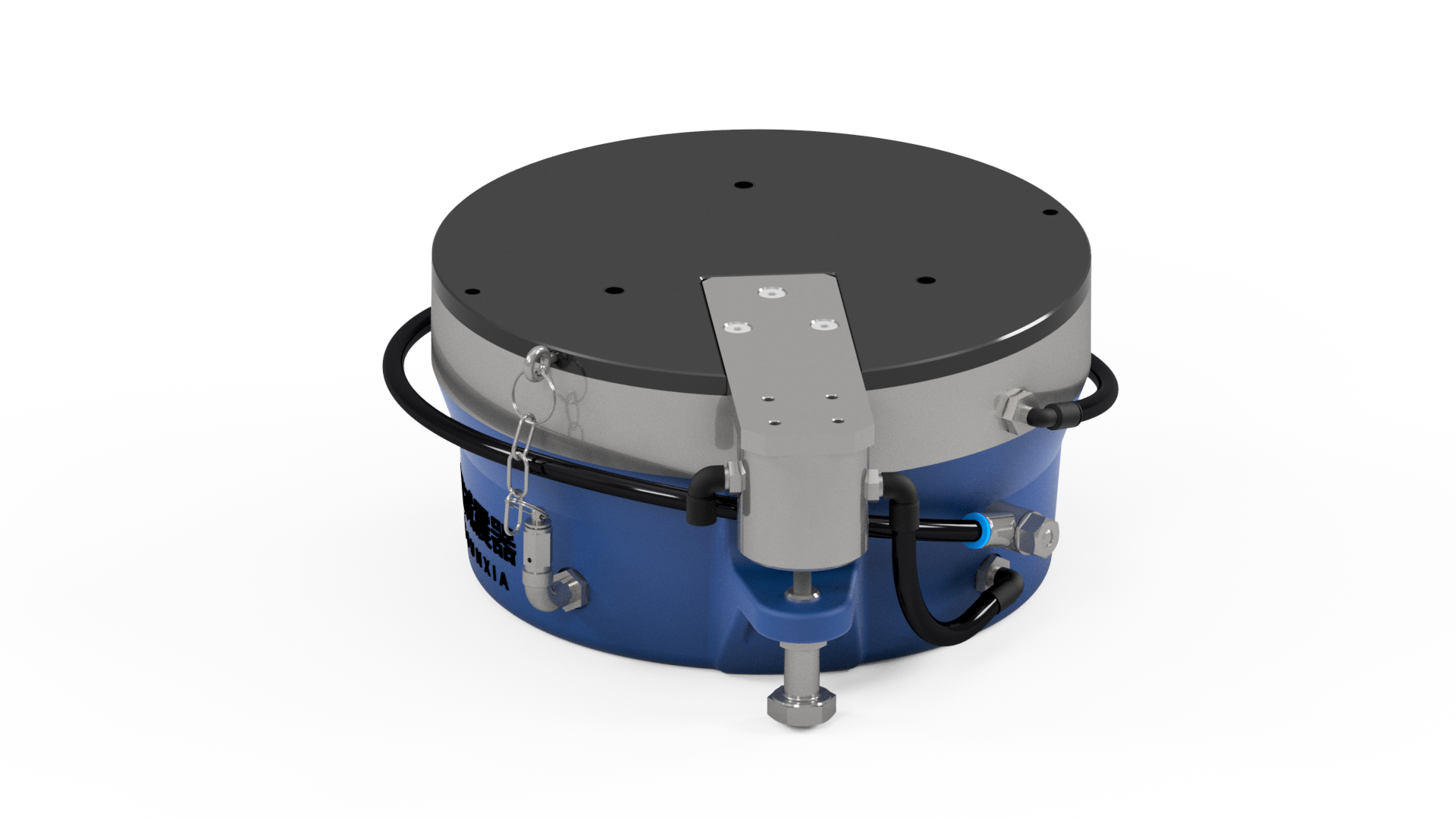
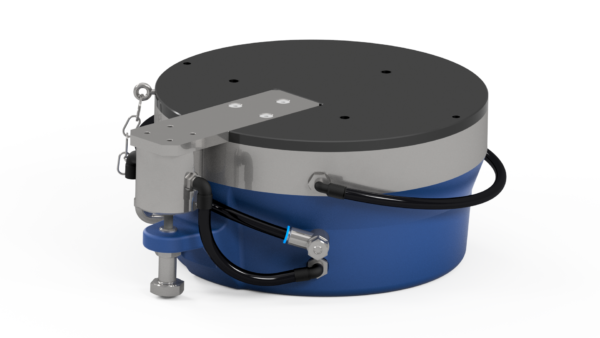
Image caption: SDB type pneumatic vibration isolator manufactured by Shanghai Songxia Shock Absorber Co., Ltd., featuring a circular load-support plate, compact metal housing, and external pneumatic and mechanical components.
The SDB type pneumatic vibration isolator shown in the product image features a circular upper support plate, a cylindrical intermediate section, and a blue metal base.
An external assembly is mounted alongside the main isolator body, with pneumatic tubing and mechanical connection components visible.
The general arrangement is suitable for integration into engineered vibration isolation systems where load support, mounting compatibility, and control of mechanical motion are important.
The specific functions of the external assembly, including whether it incorporates height sensing or automatic leveling, should be confirmed against the corresponding SDB product specification.
2. Structural Components of the SDB Pneumatic Isolator
The visible product configuration includes several important elements.
Circular Load-Support Plate
The upper metal plate provides a mounting interface for the supported structure.
Its diameter, mounting-hole pattern, surface flatness, and structural rigidity should be evaluated according to the machine installation requirements.
Uneven loading or excessive moment loads can adversely affect isolator performance.
Intermediate Isolation Section
The intermediate section forms part of the assembly separating the upper support plate from the base.
In pneumatic isolation equipment, elastic behavior is generated by the combined response of the compressed-air system and mechanical supporting elements.
The precise internal construction of the SDB model must be confirmed from sectional drawings or manufacturer documentation.
Metal Base Assembly
The blue metal housing provides a structural interface for the isolator assembly.
Correct fastening, mounting alignment, and supporting-frame stiffness are important for reliable integration.
Pneumatic Connections and External Assembly
The visible tubing indicates that the product incorporates pneumatic connections.
Depending on the final model configuration, pneumatic systems may be equipped with pressure regulation, leveling mechanisms, or additional control components.
These features must not be assumed without checking the actual SDB configuration.
3. Working Principle of Pneumatic Vibration Isolation
The basic function of a pneumatic vibration isolator is to support a static load while introducing elastic compliance between the machine and the supporting foundation.
For a simplified mechanical system, the natural frequency is:
fₙ = (1 / 2π) × √(k / m)
Where:
- fₙ is the natural frequency in hertz.
- k is the equivalent dynamic stiffness in newtons per meter.
- m is the supported mass in kilograms.
This relationship demonstrates the influence of stiffness and mass on isolation performance.
For a given supported mass, reducing the effective stiffness generally lowers the natural frequency.
However, lower stiffness also increases the potential for motion under static or dynamic disturbances.
The design must therefore balance vibration attenuation, displacement limits, mechanical stability, and disturbance recovery.
Pneumatic Stiffness
For an idealized air chamber with constant effective area, a simplified expression for pneumatic stiffness is:
kₐ ≈ nPA² / V
Where:
- kₐ = pneumatic stiffness
- n = effective polytropic exponent
- P = absolute pressure
- A = effective pressure area
- V = effective air volume
This expression represents a simplified small-displacement model.
The actual stiffness of a pneumatic isolator may also depend on diaphragm geometry, effective-area variation, elastomer properties, airflow restrictions, and connected pneumatic volume.
Manufacturer load-deflection and dynamic stiffness data should be used for accurate engineering selection.
4. Vibration Transmissibility and Isolation Efficiency
The vibration isolation performance of a system depends on the relationship between excitation frequency and natural frequency.
For an idealized single-degree-of-freedom system with viscous damping under harmonic base excitation:
T = √[(1 + (2ζr)²) / ((1 − r²)² + (2ζr)²)]
Where:
- T = absolute displacement transmissibility
- ζ = damping ratio
- r = excitation frequency divided by natural frequency
For this model, vibration attenuation occurs when the excitation frequency is greater than approximately √2 times the natural frequency.
Near resonance, vibration amplification may occur.
Proper damping is needed to limit excessive resonant motion, although damping can also influence higher-frequency isolation performance.
For precision machinery, the evaluation should extend beyond vertical motion to include horizontal translation and rotational modes.
5. Potential Applications of SDB Pneumatic Vibration Isolators
The SDB type pneumatic isolator may be considered for several categories of industrial equipment, subject to verification of its actual load capacity and dynamic characteristics.
Precision Measurement Equipment
Precision metrology equipment can be sensitive to environmental vibration.
A suitable pneumatic isolation system may reduce vibration transmitted from the floor, helping maintain more stable measurement conditions.
Optical Inspection Systems
Optical inspection equipment can experience performance degradation when structural vibration affects the relative motion between optical components and the measured object.
Proper isolation design can reduce selected disturbances.
Semiconductor Equipment Platforms
Semiconductor inspection, measurement, and certain manufacturing platforms may require controlled vibration environments.
For systems incorporating moving stages, the isolation design must account for acceleration reaction forces, dynamic load transfer, and settling-time requirements.
Laboratory and Research Equipment
Laboratory instruments and experimental platforms may benefit from pneumatic support systems where low-frequency vibration isolation is required.
Industrial Equipment Integration
In some industrial machinery applications, pneumatic vibration isolation can be combined with structural supports, displacement restraints, and additional damping components.
The selection must consider both static load support and operating disturbances.
6. Passive Pneumatic Isolation vs. Automatic Leveling and Active Control
These three functions should be distinguished during the design process.
Passive pneumatic isolation uses air compressibility and mechanical compliance to reduce vibration transmission without requiring continuous active cancellation forces.
Automatic leveling uses a height-control mechanism to adjust air pressure or volume and maintain a desired operating position under changing static or slowly varying loads.
Active vibration control uses sensors, control algorithms, and actuators to generate corrective actions intended to reduce measured disturbances.
Automatic leveling is not equivalent to active vibration cancellation.
Whether the SDB model supports any specific leveling or active control function depends on its actual configuration and compatible accessories.
7. Engineering Selection Parameters
Selecting an SDB pneumatic vibration isolator requires evaluation of the complete machine and support arrangement.
| Parameter | Engineering Requirement |
|---|---|
| Supported mass | Total equipment and platform mass |
| Load distribution | Static load on each isolator |
| Center of gravity | Position relative to support points |
| Operating pressure | Pressure range permitted by the manufacturer |
| Natural frequency | Required vertical and horizontal performance |
| Damping | Resonance control and dynamic response |
| Allowable stroke | Permitted vertical and lateral displacement |
| Mounting geometry | Installation dimensions and interface compatibility |
| Disturbance spectrum | Frequency and amplitude of external excitation |
| Settling time | Required recovery after equipment motion |
For a system supported by multiple isolators, the individual loads may differ significantly because of center-of-gravity offset.
A simplified average load calculation is useful only as an initial estimate.
Final selection should consider static equilibrium, rotational stiffness, dynamic coupling, and structural support conditions.
8. Important Considerations for Precision Machinery
Center-of-Gravity and Rotational Stability
A low vertical natural frequency does not guarantee good six-degree-of-freedom performance.
Pitch, roll, yaw, and horizontal translation may introduce additional resonances.
Motion-Induced Disturbances
Machines with accelerating linear stages generate reaction forces.
These disturbances may cause platform translation or rotation, particularly when the support system has low stiffness.
Pneumatic Supply Stability
Pressure regulation and air-line configuration can affect operating conditions.
Air supply quality, pressure variation, leakage, and maintenance requirements should be considered during integration.
Mechanical Safety
Displacement limits, abnormal pressure conditions, and equipment stability should be reviewed.
Where required, mechanical stops or safety restraints should be incorporated into the overall design.
Verification Testing
After installation, performance should be verified using appropriate measurements.
Depending on project requirements, these may include floor and equipment acceleration, frequency response, resonance behavior, operating height, and settling-time measurements.
9. Working with a Pneumatic Vibration Isolator Manufacturer
An experienced vibration isolator manufacturer should provide sufficient technical information for product selection and system integration.
Useful engineering documentation includes:
- Product dimensional drawings
- Load and operating-pressure specifications
- Static and dynamic stiffness characteristics
- Allowable displacement data
- Mounting and installation requirements
- Pneumatic connection information
- Compatible control accessories
- Inspection and maintenance recommendations
Shanghai Songxia Shock Absorber Co., Ltd. offers industrial vibration isolation products and application-oriented engineering support.
For the SDB series, customers should confirm the specific model configuration and operating characteristics before finalizing system design.
10. Conclusion
The SDB type pneumatic vibration isolator represents a compact approach to pneumatic load support and industrial vibration isolation.
Its visible configuration includes a circular supporting plate, a metal housing, pneumatic connections, and external mechanical components.
In precision equipment applications, effective vibration isolation depends on appropriate dynamic stiffness, load distribution, damping, installation geometry, and operating conditions.
The performance of a complete isolation system should be evaluated through engineering calculations and relevant product data rather than appearance or generic product claims.
Looking for SDB Pneumatic Vibration Isolators?
Shanghai Songxia Shock Absorber Co., Ltd.
For SDB product selection, equipment integration, or customized vibration isolation solutions, contact our technical team with your application requirements.
Please provide equipment mass, installation dimensions, disturbance characteristics, and performance targets so that an appropriate configuration can be evaluated.
Website: https://airisolator.com
Contact Songxia for SDB pneumatic vibration isolator product information and engineering consultation.
Request A Free Quote
Interested in SDB Type Pneumatic Vibration Isolators: Design, Working Principles, and Precision Equipment Applications? Share your required size, pressure class, material and quantities, and our team will get back to you within 24 hours.