Industrial Rubber Air Springs: Factory Shipment, Design Principles, and Vibration Isolation Applications
Industrial Rubber Air Springs: Factory Shipment, Design Principles, and Vibration Isolation Applications
By Shanghai Songxia Shock Absorber Co., Ltd. — Technical Department
Industrial rubber air springs are important pneumatic components used in machinery support, vibration isolation, and industrial motion systems. Their combination of reinforced elastomeric construction and compressed-air elasticity offers engineers an alternative to conventional mechanical springs and solid rubber mounts.
Shanghai Songxia Shock Absorber Co., Ltd., a China-based manufacturer of industrial vibration control products, supplies air spring solutions for different machinery and equipment requirements.
This article introduces a factory shipment of large multi-convoluted rubber air springs and examines their mechanical construction, pneumatic operating principles, dynamic behavior, industrial applications, and selection requirements.
1. Factory Shipment of Large Industrial Rubber Air Springs
[Insert the original factory shipment photograph here]
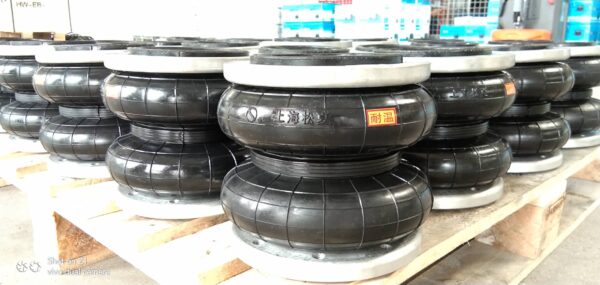
Image caption: Large multi-convoluted industrial rubber air springs with metal mounting flanges arranged on wooden pallets at the Songxia factory.
The photograph shows a batch of large-diameter rubber air spring assemblies arranged in rows on wooden pallets inside an industrial facility.
Each visible assembly features a black multi-convoluted elastomeric body combined with metallic end flanges. This type of construction is associated with pneumatic components designed to support loads while allowing controlled elastic deformation.
The multiple convolutions provide an extended flexible structure, although the actual allowable stroke, force characteristics, and operating pressure must be determined from the specific product design.
For industrial buyers, factory shipment photographs provide a useful reference for product appearance, construction, and physical scale. Nevertheless, technical suitability must always be established through dimensional drawings, performance data, and application-specific engineering calculations.
2. What Is a Multi-Convoluted Rubber Air Spring?
A multi-convoluted rubber air spring is a pneumatic elastic element consisting of a flexible, reinforced rubber body and mechanical end connections.
Compressed air inside the assembly creates a supporting force. As the spring compresses or extends, changes in chamber volume, internal pressure, and effective pressure area affect its force-displacement behavior.
Common design elements may include:
- Reinforced elastomeric bellows
- Metal end plates or mounting flanges
- Pneumatic connection ports
- Internal reinforcement layers
- Sealing interfaces
- Optional external mechanical restraints
Compared with a single-convolution design, a multi-convoluted configuration may provide a different operating-height range, displacement capability, and stiffness characteristic.
However, a greater number of convolutions does not automatically mean better vibration isolation. The dynamic behavior depends on the complete pneumatic and mechanical design.
3. How Do Industrial Air Springs Support Loads?
The load-support behavior of a pneumatic air spring can be approximated by considering the internal pressure and effective pressure area.
For a simplified model:
F ≈ ΔP × Aₑ
Where:
- F = pneumatic supporting force (N)
- ΔP = internal gauge pressure relative to ambient pressure (Pa)
- Aₑ = effective pressure area (m²)
This approximation is useful for preliminary engineering analysis.
However, the actual force generated by a reinforced rubber air spring may also be affected by elastomer deformation, reinforcement geometry, frictional effects, and changes in effective area with operating height.
For example, increasing internal pressure generally increases the force available at a given operating height.
The allowable working pressure and load must remain within the manufacturer’s specified limits.
An industrial air spring should not be selected solely from its outside diameter or visual appearance.
4. Pneumatic Stiffness and Natural Frequency
One of the most important parameters in vibration isolation engineering is the natural frequency of the supported system.
For an idealized single-degree-of-freedom model:
fₙ = (1 / 2π) × √(kₑ / m)
Where:
- fₙ = natural frequency (Hz)
- kₑ = equivalent dynamic stiffness (N/m)
- m = supported mass (kg)
For a pneumatic system, the total effective stiffness is influenced by compressed-air behavior and by the mechanical characteristics of the rubber structure.
A simplified gas-stiffness contribution can be expressed as:
kₐ ≈ nPAₑ² / V
Where:
- kₐ = approximate pneumatic stiffness (N/m)
- n = effective polytropic exponent
- P = absolute air pressure (Pa)
- Aₑ = effective pressure area (m²)
- V = effective compressed-air volume (m³)
This expression assumes small displacements, approximately constant effective area, and an idealized pneumatic chamber.
In practical bellows, the effective area changes with displacement. The resulting geometric stiffness contribution, along with the rubber structure’s stiffness, must be considered.
Airflow restrictions, external reservoirs, air-line volume, and excitation frequency may further affect dynamic stiffness and damping.
Consequently, accurate isolation predictions should use experimentally determined product stiffness characteristics wherever available.
5. Why Air Springs Are Used for Industrial Vibration Isolation
5.1 Reduced Transmission of High-Frequency Disturbances
A properly engineered pneumatic isolation system can reduce vibration transmission when the excitation frequency is sufficiently higher than the system natural frequency.
This helps limit disturbances transmitted between machinery and supporting structures.
5.2 Adjustable Operating Conditions
Air pressure can be regulated to achieve suitable static support conditions over the product’s specified operating range.
Pressure adjustment should not be confused with unrestricted stiffness control, since loading and operating height also affect the system.
5.3 Load Support and Structural Compliance
Rubber air springs can support substantial equipment loads while providing elastic compliance.
This makes them useful for certain industrial suspension and isolation applications.
5.4 Flexible System Integration
Depending on the application, pneumatic springs can be combined with mounting frames, leveling controls, auxiliary air reservoirs, dampers, and mechanical travel stops.
The final arrangement should be developed around the equipment’s operating requirements.
6. Vibration Transmissibility and Isolation Performance
A central engineering objective is to reduce transmitted vibration without introducing excessive motion around the isolation system’s resonance.
For a simplified, linear, viscously damped, single-degree-of-freedom system under harmonic base excitation, absolute displacement transmissibility is:
T = √[(1 + (2ζr)²) / ((1 − r²)² + (2ζr)²)]
Where:
- T = absolute displacement transmissibility
- ζ = damping ratio
- r = f / fₙ = frequency ratio
- f = excitation frequency
For this idealized model, transmissibility becomes less than unity when the excitation frequency exceeds approximately √2 times the natural frequency.
Near resonance, vibration amplification may occur.
Although damping helps reduce resonance amplification, excessive viscous damping may also increase high-frequency transmissibility.
Therefore, the selection process should balance low natural frequency, adequate damping, displacement limits, and operational stability.
In complex industrial equipment, vertical, horizontal, pitch, roll, and yaw modes must also be considered.
7. Typical Applications of Rubber Air Springs
Industrial Machinery Isolation
Rubber air springs may be used in selected industrial machinery installations where vibration isolation and elastic load support are required.
Their suitability depends on vibration frequency, dynamic loading, installation geometry, and operational displacement limits.
Precision Equipment Support
Pneumatic isolation systems can support inspection machines, measurement platforms, and other equipment sensitive to floor vibration.
For precision applications, the complete system must be evaluated for vertical and horizontal stiffness, rotational modes, stability, and leveling performance.
Industrial Suspension Systems
Air springs are used in various industrial suspension arrangements where controllable pneumatic load support and mechanical compliance are necessary.
Custom Vibration Isolation Platforms
Air spring systems can be integrated into custom support platforms, subject to proper engineering design.
For equipment with rapid accelerations or shifting loads, additional damping, restraints, or active control may be required.
8. How to Select Industrial Rubber Air Springs
A suitable selection process should consider the following engineering parameters.
| Parameter | Engineering Significance |
|---|---|
| Supported load | Determines the load requirement for each air spring |
| Operating pressure | Influences available pneumatic support force |
| Effective area | Affects load capacity and pneumatic stiffness |
| Operating height | Defines the intended static installation condition |
| Allowable stroke | Limits permitted compression and extension |
| Vertical stiffness | Influences vertical natural frequency |
| Horizontal stiffness | Affects lateral motion and system stability |
| Dynamic damping | Influences resonance response |
| Mounting dimensions | Determines mechanical compatibility |
| Operating environment | Affects material selection and service conditions |
For equipment supported by multiple air springs, the center of gravity and actual load distribution must be included in the calculation.
A nominal four-point support layout does not guarantee equal load distribution.
The final isolation performance also depends on the supporting structure, air supply arrangement, connected components, and machine operating conditions.
9. Important Design Considerations for Multi-Convoluted Air Springs
Multi-convoluted air springs are not inherently suitable for every machine.
Engineers should examine several potential limitations.
Lateral stability: Pneumatic bellows can exhibit relatively low lateral stiffness in certain configurations. Guidance or mechanical restraints may be necessary.
Pressure safety: Air pressure must remain within the specified operating limits. Pressure relief and monitoring may be appropriate depending on the application.
Overtravel protection: Mechanical stops can help prevent excessive displacement during abnormal operating conditions.
Resonance: Soft isolation mounts may amplify motion near their natural frequencies.
Load changes: Variable loads can affect working height, pressure, natural frequency, and stability.
Environmental compatibility: Rubber compounds must be selected for the actual temperature, chemical exposure, and service environment.
These considerations should be addressed before final equipment installation.
10. Choosing a Rubber Air Spring Manufacturer in China
When sourcing industrial rubber air springs, buyers should evaluate more than unit price.
Relevant supplier evaluation criteria include:
- Product dimensional and installation drawings
- Verified pressure and load ratings
- Load-versus-height characteristics
- Dynamic stiffness data where required
- Material compatibility information
- Technical selection support
- Application-specific customization capability
- Documented inspection and testing procedures
Shanghai Songxia Shock Absorber Co., Ltd. supplies industrial air spring and vibration isolation products for machinery-related applications.
The factory photograph accompanying this article illustrates a batch of multi-convoluted rubber air springs prepared for industrial handling and shipment.
For custom engineering projects, buyers should provide the relevant load conditions, mounting constraints, operating pressures, vibration frequencies, and performance targets before selecting a product.
11. Conclusion
Industrial rubber air springs provide pneumatic load support and elastic compliance for a range of industrial machinery and vibration isolation applications.
Multi-convoluted designs offer distinctive geometric and mechanical characteristics, but successful vibration control depends on proper engineering calculations rather than the number of bellows convolutions alone.
Important factors include effective pressure area, pneumatic stiffness, operating pressure, supported mass, natural frequency, damping, and displacement limits.
By evaluating these factors systematically, equipment designers and buyers can make better-informed choices when integrating rubber air springs into industrial systems.
Looking for Industrial Rubber Air Springs?
Shanghai Songxia Shock Absorber Co., Ltd. provides industrial air spring products and vibration control solutions for industrial equipment applications.
For product selection or customization inquiries, please provide:
- Equipment weight and load distribution
- Required working height
- Expected operating pressure
- Maximum movement or stroke
- Vibration frequency range
- Mounting dimensions
- Application environment
Visit: https://airisolator.com
Contact our technical team to discuss suitable industrial air spring and vibration isolation solutions.