Air Spring Vibration Isolators | Factory Shipment & Applications
Air Spring Vibration Isolators: Factory Shipment, Working Principles, and Industrial Applications
Industrial Vibration Isolation Solutions from Shanghai Songxia Shock Absorber Co., Ltd.
Industrial vibration control plays an important role in maintaining equipment stability, reducing vibration transmission, and supporting reliable machinery operation. As industrial systems become increasingly sophisticated, selecting an appropriate vibration isolation solution is essential for both machine manufacturers and industrial end users.
Air spring vibration isolators are widely considered for applications requiring adjustable load support, relatively low natural frequencies, and controlled vibration transmission.
Shanghai Songxia Shock Absorber Co., Ltd., an industrial vibration isolation equipment manufacturer in China, supplies vibration isolation products and customized solutions for a range of industrial applications.
This article presents a factory shipment of industrial air spring vibration isolators and explains their operating principles, engineering advantages, selection criteria, and potential applications.
1. Factory Shipment of Industrial Air Spring Vibration Isolators
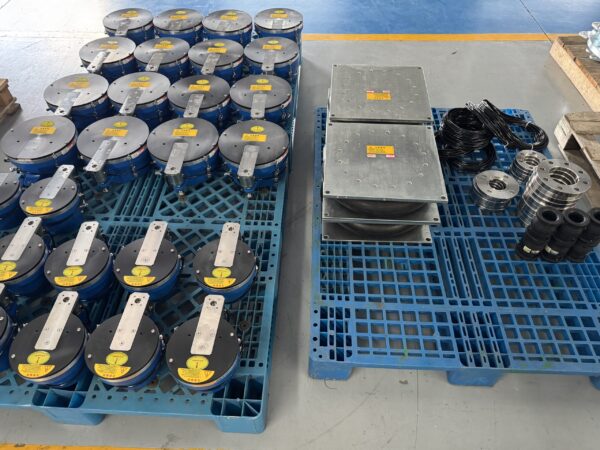
[Insert original factory shipment photograph here]
Image caption: Industrial air spring vibration isolators and associated installation components arranged on pallets for shipment at Shanghai Songxia Shock Absorber Co., Ltd.
The factory photograph shows multiple industrial air spring vibration isolator assemblies arranged on blue shipping pallets. The visible products include circular isolation units with metal top plates, while additional mounting components and accessories are positioned nearby.
The photograph provides a practical view of the products and components prepared for industrial delivery.
For international machinery manufacturers, equipment integrators, and industrial buyers, understanding the construction and installation requirements of vibration isolation equipment is important when evaluating potential suppliers.
A vibration isolation system should not be selected solely by appearance. The final configuration must be based on equipment mass, center of gravity, excitation characteristics, installation conditions, and required vibration performance.
2. What Is an Air Spring Vibration Isolator?
An air spring vibration isolator is a mechanical support device that uses compressed air as an elastic medium to carry static loads while reducing the transmission of certain dynamic forces and displacements.
Unlike conventional rubber mounts with primarily material-dependent stiffness, pneumatic isolators can offer adjustable operating conditions through changes in internal pressure and, depending on their design, effective air volume.
A typical industrial pneumatic vibration isolation assembly may incorporate:
- A pneumatic air spring or air chamber
- Metal mounting and load-transfer components
- Air supply connections
- Optional height-control or leveling valves
- Optional pressure regulators and control units
- Mechanical stops or displacement restraints where required
The exact construction depends on the isolator model and application.
Air spring isolators can be integrated into both passive and actively regulated systems. However, pressure regulation or automatic leveling alone does not necessarily make an isolation system an active vibration cancellation system.
3. How Do Pneumatic Vibration Isolators Work?
The fundamental function of an air spring isolator is to provide elastic support while reducing vibration transmission over an appropriate frequency range.
For a simplified single-degree-of-freedom isolation system, the undamped natural frequency is:
fₙ = (1 / 2π) × √(k / m)
Where:
- fₙ = natural frequency (Hz)
- k = equivalent vertical stiffness (N/m)
- m = supported mass (kg)
For pneumatic isolation equipment, effective stiffness depends on factors including air chamber geometry, internal pressure, gas compression characteristics, and any connected auxiliary air volume.
The effectiveness of vibration isolation depends strongly on the relationship between excitation frequency and system natural frequency.
For a simplified viscously damped, linear single-degree-of-freedom model, the vibration transmissibility under harmonic base excitation is:
T = √[(1 + (2ζr)²) / ((1 − r²)² + (2ζr)²)]
Where:
- T = absolute displacement transmissibility
- ζ = damping ratio
- r = f / fₙ = excitation-to-natural-frequency ratio
For this simplified model, isolation begins when the frequency ratio exceeds √2.
At frequencies close to the natural frequency, resonance amplification may occur. Appropriate damping is therefore necessary to control resonant motion.
In real industrial installations, six-degree-of-freedom motion, structural flexibility, nonlinear stiffness, changing loads, and pneumatic control behavior can all influence performance.
For this reason, theoretical isolation calculations should be verified against the actual product characteristics and installation conditions.
4. Engineering Advantages of Industrial Air Spring Isolation Systems
4.1 Adjustable Load Support
Pneumatic isolation systems allow load-support conditions to be adjusted within the manufacturer’s permissible operating range.
This can be valuable for machinery with different operating masses or installations requiring precise height adjustment.
4.2 Low-Frequency Vibration Isolation
Properly designed air spring systems can provide lower natural frequencies than many conventional rigid or elastomeric mounting arrangements.
However, actual low-frequency performance depends on the effective stiffness, supported mass, air volume, and damping configuration.
4.3 Reduced Vibration Transmission
When correctly selected, industrial air spring vibration isolators can help reduce vibration transmission between machines and their supporting structures.
This is relevant when protecting sensitive equipment from floor vibration or reducing machine-induced vibration transmitted to surrounding facilities.
4.4 Automatic Leveling Options
Some pneumatic vibration isolation systems can incorporate mechanical or electronically controlled leveling mechanisms.
These systems can compensate for slow load changes and maintain a desired operating height within the system’s control capabilities.
4.5 Customized System Integration
Industrial machines differ in mass distribution, excitation frequency, operating environment, and mechanical interface requirements.
Custom vibration isolation systems may therefore require tailored mounting arrangements, pneumatic circuits, displacement restraints, and control components.
5. Typical Industrial Applications
Precision Manufacturing Equipment
Precision measurement and manufacturing equipment may benefit from low-frequency isolation systems when floor vibration interferes with equipment performance.
Selection should consider instrument sensitivity, allowable displacement, and required settling time.
Semiconductor Manufacturing Equipment
Wafer inspection, metrology, and certain semiconductor processing platforms may require vibration isolation to reduce disturbances affecting precision operations.
For systems incorporating rapidly accelerating motion stages, isolation design must also account for reaction forces and the interaction between stage motion and the support structure.
Optical and Laboratory Equipment
Optical inspection systems, microscopy platforms, and laboratory instruments may require vibration isolation to protect measurement stability.
Industrial Machinery
Compressors, pumps, manufacturing machines, and other rotating or reciprocating equipment may require vibration isolation to reduce structure-borne vibration.
Not every industrial machine is suitable for a soft pneumatic support system. Large dynamic forces, significant horizontal loading, or strict displacement limits may require additional restraints or alternative isolation designs.
6. How to Select the Right Air Spring Vibration Isolator
Selecting a suitable pneumatic vibration isolator requires more than matching the nominal weight capacity.
Step 1: Determine the Total Supported Mass
Include the machine, mounting frame, tooling, accessories, and other supported components.
Step 2: Evaluate the Center of Gravity
The load distribution across individual isolators depends on support geometry and the center of gravity.
Uneven load distribution can cause different air spring pressures and affect the system’s vertical and rotational behavior.
Step 3: Identify the Excitation Frequencies
Determine whether the main disturbance comes from floor vibration, rotating components, reciprocating forces, impact events, or motion-stage acceleration.
Step 4: Define Performance Requirements
Specify measurable targets such as:
- Target natural frequency
- Required vibration transmissibility
- Maximum operating displacement
- Allowable static deflection
- Leveling accuracy
- Settling time after disturbances
Step 5: Evaluate the Installation Environment
Consider available compressed air, installation space, temperature, contamination constraints, maintenance access, and any special safety requirements.
Step 6: Verify the Final Configuration
The selected isolation system should be assessed using relevant load calculations, stiffness data, structural considerations, and, where practical, on-site vibration measurements.
7. Important Considerations for Low-Frequency Vibration Control
Air springs are valuable engineering components, but they are not universal solutions for every vibration problem.
A passive isolation system can attenuate vibration above its isolation threshold while allowing amplification near resonance.
At very low excitation frequencies, increasing compliance may create undesired displacement or stability issues.
For equipment requiring both excellent low-frequency isolation and rapid disturbance recovery, the design may involve:
- Pneumatic leveling control
- Additional damping mechanisms
- Inertial feedback control
- Feedforward compensation of known disturbances
- Mechanical displacement limiting devices
These features serve different purposes and must be engineered as an integrated system.
In particular, active feedback or feedforward control should not be assumed to be included in a standard air spring isolator.
8. Working with a Vibration Isolator Manufacturer
For B2B industrial buyers, a suitable vibration isolator manufacturer should be able to discuss the engineering requirements behind a product recommendation.
Important questions include:
- What is the allowable static load range?
- How does vertical stiffness change with operating pressure?
- What are the horizontal stiffness characteristics?
- What natural frequency can be expected under the specified load?
- Are leveling controls or displacement restraints required?
- What mounting interfaces and pneumatic accessories are needed?
- How will installation performance be verified?
Shanghai Songxia Shock Absorber Co., Ltd. provides industrial vibration isolation products and works with customers on application-specific vibration control requirements.
For customized projects, the technical evaluation should begin with the actual machine specifications rather than a generic product recommendation.
9. Conclusion
Industrial air spring vibration isolators offer a flexible approach to machinery support and vibration control.
The factory shipment photograph illustrates the physical products and installation components associated with industrial vibration isolation equipment.
However, effective vibration isolation requires more than selecting an air spring based on its appearance or nominal load rating.
A successful solution must consider system natural frequencies, vibration transmissibility, damping, load distribution, installation geometry, and operational disturbances.
For projects involving industrial machinery, precision manufacturing, or customized pneumatic isolation equipment, working with a technically capable manufacturer can help improve system selection and integration.
Looking for Industrial Air Spring Vibration Isolators?
Contact Shanghai Songxia Shock Absorber Co., Ltd. to discuss your equipment mass, vibration environment, installation configuration, and required isolation performance.
Website: https://airisolator.com
Send us your machine specifications to discuss a suitable industrial vibration isolation solution.